
Start a San Francisco Voter Lookup
Begin with the official self-service route. A San Francisco voter may sign in to the Department of Elections Voter Portal to review a voter record, check party preference, and track a vote-by-mail ballot. The portal functions as a login service rather than a list of names to browse. It is built for the voter whose record is being checked.
- Open the local voter portal and use its voter login. Have the personal details needed to authenticate the record ready.
- Review the returned registration details and party preference. Use ballot tracking when a vote-by-mail ballot is in process.
- If the local login does not resolve the issue, try the state tool or contact the Department of Elections through its official site.
The statewide My Voter Status lookup offers a second official path. Its documented fields show why a voter registration search is not an open people search.
| Lookup field | Input type | Need | How it is used |
|---|---|---|---|
| First name | Text | Required | Personal record lookup |
| Last name | Text | Required | Personal record lookup |
| Driver license, state ID, last four SSN, or birth details | Identity fields | Required or conditional | Authenticates the voter |
| County or ZIP | Dropdown or text | Conditional | Routes the voter record |
| Submit/Search | Button | Action | Returns the voter's own status |
The official San Francisco Voter Portal screen shows the local entry point:
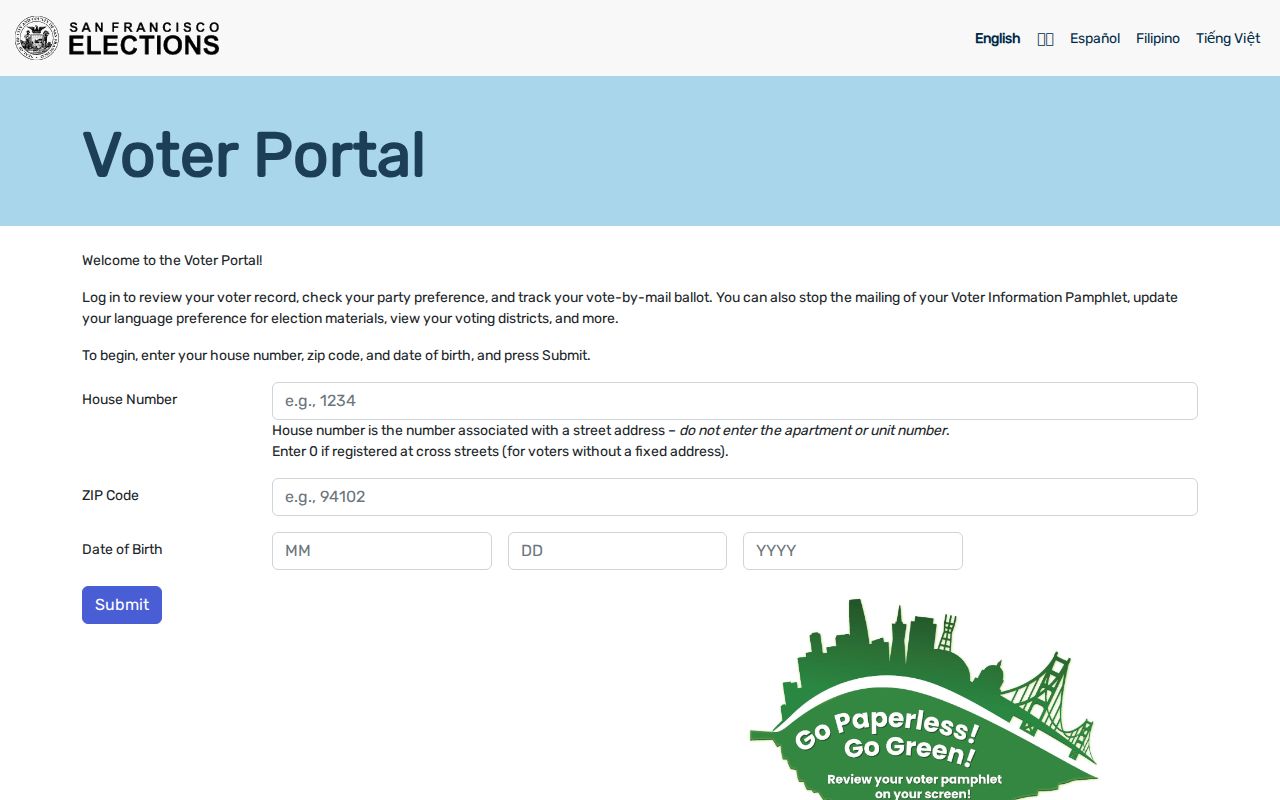
That screen should be treated as a secure voter service, not a directory for finding someone else.
Two San Francisco Voter Tools
The local and state systems overlap, but they are not identical. The San Francisco portal lets a registered voter review the local record, see party preference, and track a vote-by-mail ballot. California's tool can also show language preference for election materials, vote-by-mail or provisional-ballot status, and voting information. Neither system exposes a searchable citywide voter roll.
Use the local portal for San Francisco election administration and ballot tracking. Use My Voter Status when a statewide status check is the better fit. For a record problem that cannot be fixed online, the San Francisco Department of Elections is the local election official and the right offline contact. This gives voters three documented channels: local portal, state portal, and direct local office help.
The California My Voter Status screen shows the statewide alternative:
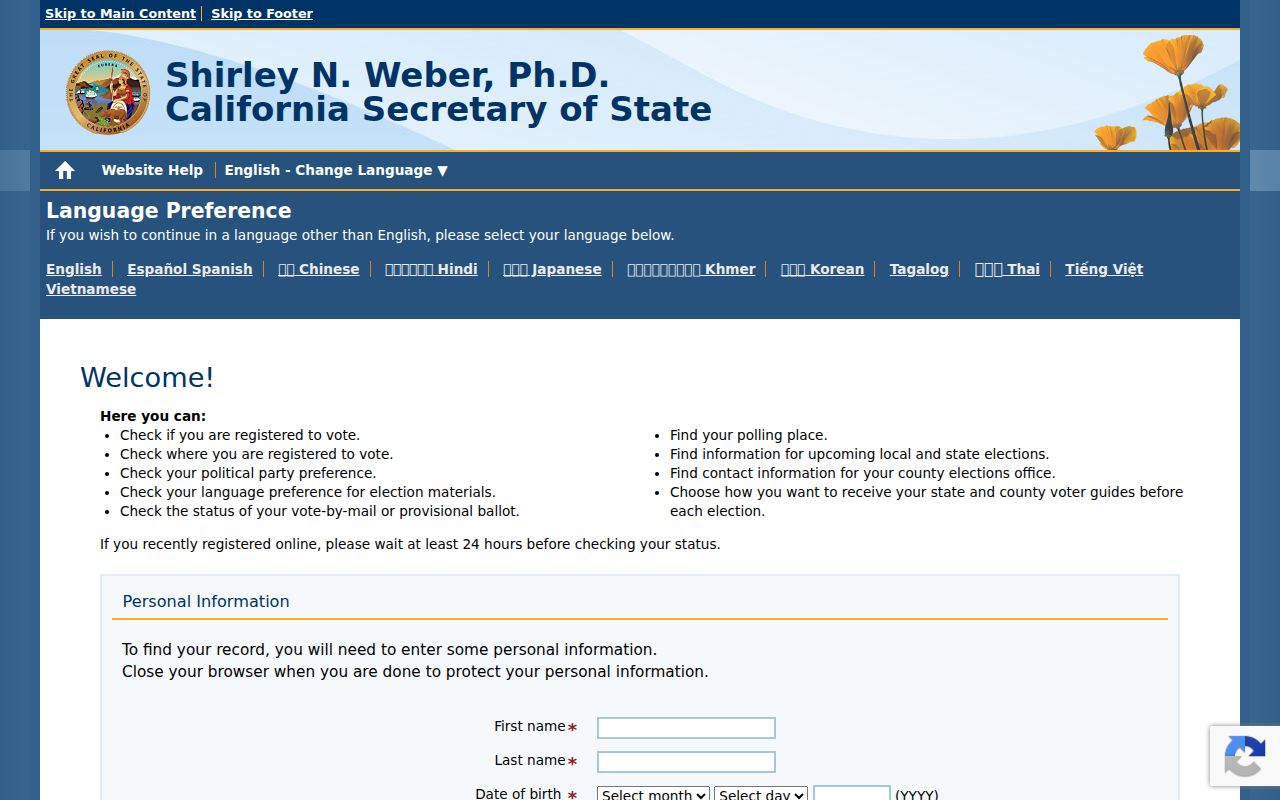
Its identity fields reinforce the key limit: the tool confirms a personal record rather than publishing voter names for general browsing.
Note: A failed self-lookup does not make the voter file open; contact the election official to resolve the record.
San Francisco Voter Records Stay Restricted
California voter registration information is not open public data. That is the central rule, even though the words “voter record” may sound like any other government record. The ordinary public records access process does not turn the voter database into a public directory. Government Code section 7924.000 and the election laws preserve a separate, controlled access system.
Elections Code section 2188 requires an application that identifies the requester, requested information, and planned use. Elections Code section 2194 narrows authorized uses to election, scholarly, journalistic, political, or governmental purposes. Related rules appear in California Code of Regulations sections 19001 through 19013. An official keeps completed applications for five years.
The open-voter-roll myth. Modern San Francisco voter registration records require self-authentication or a purpose-approved application. Historical registers at the library are a separate source.
Fields in San Francisco Voter Records
An approved voter data release can contain much more than the personal status portal shows. The Secretary of State distributes three plain-text, tab-delimited files when a qualifying request is approved: voter data, voting history, and district data. A tab-delimited file is a text file whose columns are split by tab characters, so it can be opened in common data tools.
| Name | Identifies the registered voter. |
|---|---|
| Addresses | Residence and a different mailing address may appear, unless confidentiality rules apply. |
| Registration | Party preference, registration status, and registration date may be included. |
| Election geography | Precinct and district assignments connect the voter to local contests. |
| Preferences and ballot status | Language preference and vote-by-mail status or history may appear. |
| Voting history | Shows election participation, never the voter's ballot choices. |
Inactive voter records, available voting history, and precinct-to-district data can be selected on the application. A request for named people is different: it must give full name, date of birth, county, residence address, and other identifying details. One application may seek no more than ten specific records.
Protected San Francisco Voter Addresses
Not every approved recipient receives every record. Confidential voters are excluded from ordinary releases. California's Safe at Home program gives qualifying people a substitute mailing address and helps agencies avoid disclosing an actual address in public records. Government Code sections 6205 through 6210 cover the program.
The protection can apply to victims of domestic violence, sexual assault, stalking, human trafficking, child abduction, elder or dependent-adult abuse, and some household members. Applicants work through a designated assistance program. Certification lasts four years unless withdrawn or invalidated. This is a real limit on a voter-record trail, not a missing search feature.
Confidential by law. Confidential voter records and protected addresses are not supplied to ordinary recipients. Do not try to defeat a substitute-address program.
Request San Francisco Voter File Data
The Secretary of State file-request page leads to the application used for California data. County election officials may also accept applications under section 2188, while the statewide form is the documented route for a county, statewide, district, or specific-record request.
- Download the voter-registration file application. Choose the location and data needed, including inactive records, voting history, or a district file.
- Give the applicant's contact and identity details. Identify any organization or other beneficiary, select a qualifying purpose, and explain how the data will stay secure.
- Initial the agreements and sign. Attach a clear copy of a current driver license or state ID, supporting documents, and payment.
- Mail or hand-deliver the original to Secretary of State, Elections Division, 1500 11th Street, 5th Floor, Sacramento, CA 95814. Email and fax are not accepted.
The original signature and physical delivery rule is easy to miss. Review starts after receipt and generally takes 7 to 14 business days. Requests are handled in the order received, so that window is not a promise of delivery on a fixed date.
San Francisco Voter Request Fields
The form asks for enough detail to judge both identity and purpose. It is not a short records-request letter. Accurate entries matter because the applicant and any beneficiary accept security and use duties.
| Application part | Requirement | What to provide |
|---|---|---|
| Applicant identity | Required | Full name, phone, email, business address, and mailing address if different |
| Beneficiary | Conditional | Organization, committee, or other person receiving the benefit |
| Qualification and purpose | Required | Applicable category plus a specific authorized use |
| Security plan | Required | How the files will remain secure and confidential |
| Data scope | Required | State, county, counties, district, or up to ten specific voters |
| Delivery | Required | Ship-to contact, mail or pickup choice, and available data format |
The statewide application is the decisive document, and the section 2188 source page shows its legal basis:
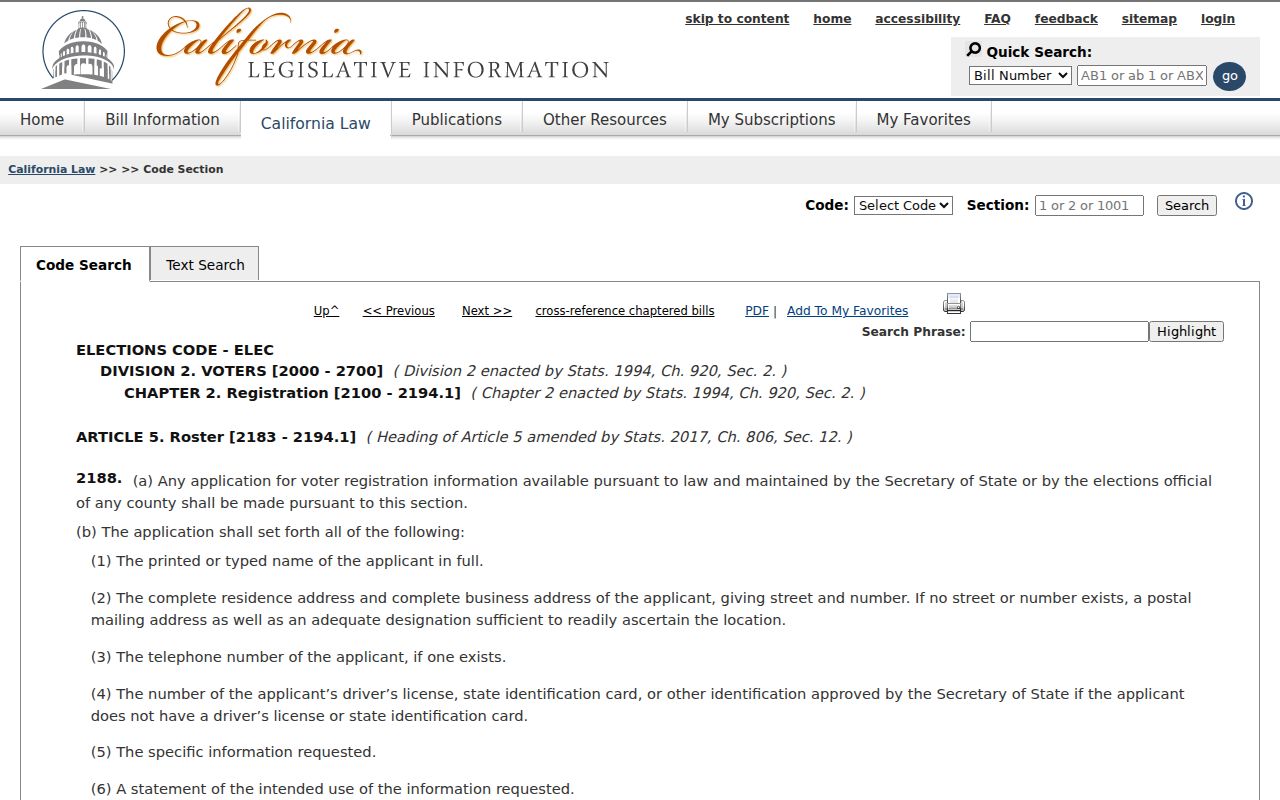
Read the current form and statute together before submitting, since approval turns on the applicant, scope, purpose, and safeguards.
Note: Private Vendor and Other are form categories, not blanket approval; the stated use still must fit California's authorized purposes.
San Francisco Voter File Delivery
Registration data costs $15 per thousand records, capped at $100. Specific-voter requests cost $30 per record, also capped at $100, and cannot exceed ten records on one application. These charges apply to the voter-file process, not to a voter checking a personal status through an online portal.
Approved county, statewide, and district files may arrive on encrypted DVD as tab-delimited text. The application also identifies secure FTP as an option in some cases. Compressed encrypted files are used in many deliveries, while specific-voter records may arrive by encrypted email in WinZip. The release can contain separate voter, history, and district files, so the recipient must be ready to store each one safely.
Limits on San Francisco Voter Data
Approved access does not confer a right to republish or reuse the file at will. California bars commercial, advertising, and marketing uses, harassment of voters or households, unauthorized sharing, and unsecured posting on the public internet. Certain unsolicited text uses are restricted as well. A recipient must keep the information secure and use it only for the purpose that supported approval.
Misuse is a misdemeanor under Elections Code section 18109 and can carry significant fines. A requester's duties also extend to any person or group that benefits from the application. These rules make a voter file unsuitable for casual curiosity, locating a protected person, or building a public name-and-address list. Suspected voter-data misuse can be reported through the Secretary of State's VoteCal help channel and the relevant election official.
Historic San Francisco Voter Registers
Historical voter rolls are far more useful for family history and address research. The San Francisco Public Library building-research guide lists an incomplete Index to the Great Register of Voters for 1866 through 1964 and 1985. Holdings are on microfilm, microfiche, and in print at the San Francisco History Center. Material from 1867 through 1940 is also online.
A Great Register entry can show an address, name, age, political affiliation, and sometimes an occupation. First verify the assembly district, since historic records are arranged by election geography. The library requires 48 hours' notice for access to registers from 1945 through 1964. That small step can save a wasted visit.
At SFPL locations, Ancestry Library Edition includes California Voter Registrations 1900-1968, with San Francisco coverage from 1900 through 1940. An address can be placed in quotation marks in keyword search. This route is well suited to tracing relatives, separating same-name residents, and testing who lived at a San Francisco address in a given era. It does not bypass current voter privacy because it uses a historical collection.