
How San Francisco Public Records Open
California's Public Records Act, Government Code section 7920.000 and following, makes non-exempt agency material available when a request reasonably describes it. San Francisco's Sunshine Ordinance, Administrative Code chapter 67, adds a local layer for city departments. Neither law turns every government file into an open name search. Access depends on the record, its custodian, the age of the material, and any privacy rule that applies.
| San Francisco record set | Official keeper | Online reach | Practical access |
|---|---|---|---|
| Deeds, liens, releases | Assessor-Recorder | Records Manager, 1990 to present | Free view; paid or certified copies |
| Property assessment and GIS | Assessor-Recorder and SF Planning | Community Portal and PIM | Free block, lot, address, or map search |
| Civil, family, probate, small claims | Superior Court | Listed case types from 1987 | Index, clerk, public terminal, copy request |
| Birth and death certificates | DPH, County Clerk, and CDPH | No current open name index | Authorized or informational copy rules |
| Local jail custody | San Francisco Sheriff | Current jail locator | Name, booking number, or SF number |
| Business and license records | California SOS and licensing boards | Statewide official searches | Free search; some certified orders cost extra |
Sealed and juvenile cases, adoption files, confidential marriages, protected voter details, Safe at Home addresses, and some victim or medical information do not become open merely because an agency holds them. Signatures, Social Security numbers, and other sensitive fields may be redacted. A public index can establish that a document or case exists without making every image or pleading available.
San Francisco Recorder Access
The Assessor-Recorder Records Manager is the central index for recorded deeds, liens, releases, reconveyances, notices, and related official documents from 1990 forward. Viewing is free when no official copy is needed. Preview access requires a registered account and identity verification, while a guest may buy a record without registering. Certified copies are not available as instant online downloads.
The date line is firm. Material recorded before January 1, 1990 must be searched at City Hall, Room 190. Copy orders also travel through more than one channel: online purchase, in-person service, mail order, or drop box. This split matters for estate work and family property history because an absent web hit may point to older indexing, not an absent deed.
The official recorded-document copy instructions show the coverage boundary and ordering choices.
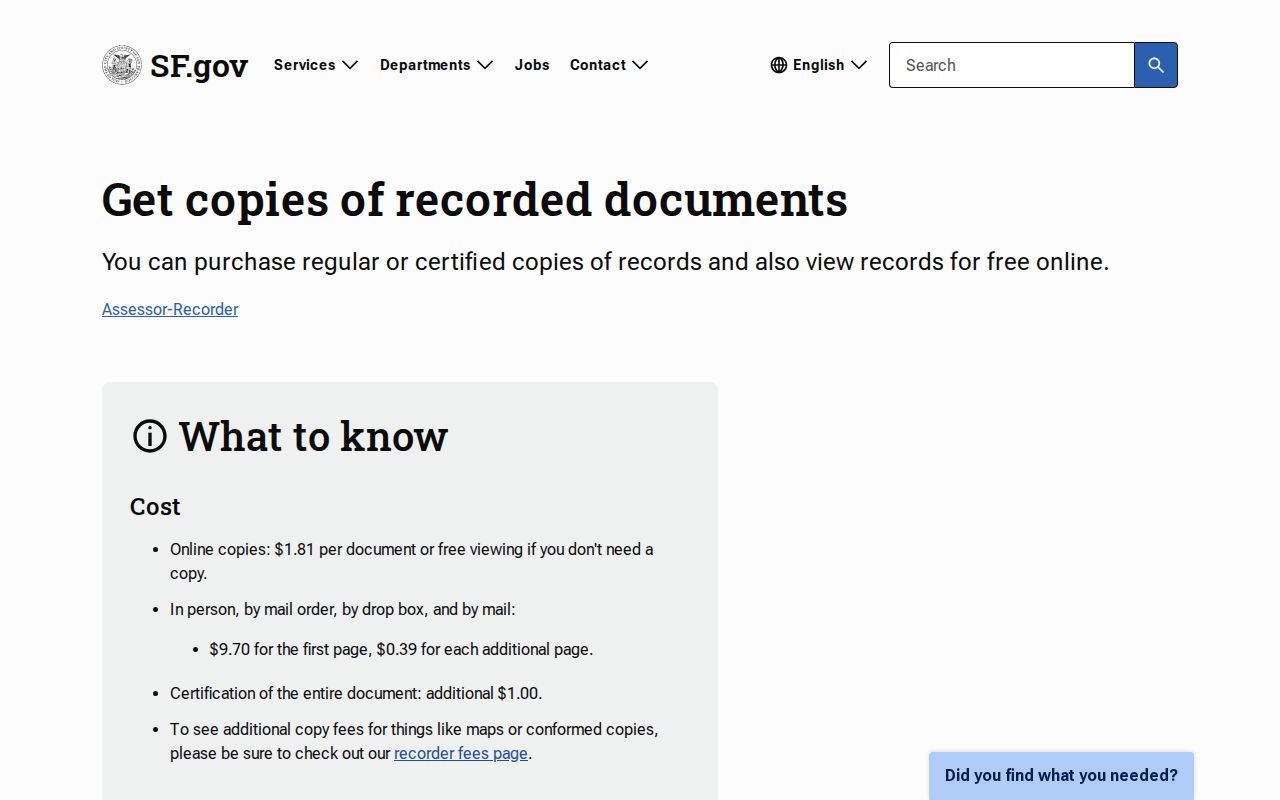
The captured page reinforces why a researcher should choose the search and copy channel by record date and by whether certification is actually needed.
San Francisco Recorder Search Fields
Basic Search accepts keywords, while Advanced Search exposes the fields that make this index useful. A grantor is a party who gives or transfers an interest. A grantee receives it. The Assessor's Parcel Number, or APN, is San Francisco's block-and-lot property identifier. Records Manager does not search by street address, so property work often begins in a separate city map.
| Portal field | Input | Required | Use or format |
|---|---|---|---|
| Basic Search | Keywords | No | Broad first pass |
| Grantor / Grantee | Name fields | No | Last, first, and middle name model |
| Document Date | Date range | No | Narrows the recording period |
| Filing Code / Type | Dropdown | No | Filters document class |
| Document Number | Text or range | No | Direct record-number route |
| Book / Page | Text | No | Older citation path |
| Property ID / APN | Block-lot | No | No street-address search |
Search broad names with care. Initials, former names, entity names, and small spelling changes can separate one party from another. The returned index may show document number, date, type, pages, property ID, and named parties. The image is the recorded page itself, while an index is the finding aid that points to it.
Block-Lot Keys for San Francisco Records
San Francisco's records geography runs through block and lot. The Property Information Map, known as PIM, accepts an address, block-lot, street intersection, or map selection. It can return the parcel number, official address, permit history, zoning, ZIP code, taxable values, build date, and related map layers. The Assessor-Recorder Community Portal accepts a block, a block-and-lot pair, or a structured property address.
The clean handoff is address to PIM, PIM to block-lot, and block-lot to the recorder index. This is a geographic access rule, not a mere search trick. PIM and the assessor describe a parcel; Records Manager points to recorded transfers and other documents. One tool cannot replace the others.
Block-lot bridge. If only a street address is known, find its block-lot in PIM before opening the recorder's APN field.
Recent Assessor-Recorder modernization also expands remote property work. The Community Portal provides property characteristics, current assessed value, assessment history, filing choices, mailing-address changes, and service-request functions. Public guidance does not promise an owner-name search, so use only the documented block, block-lot, and address routes.
San Francisco Records Office Channels
Because San Francisco is both city and county, key custodians are concentrated within the same local government. Each office still controls its own record set, portal, copy process, and disclosure limits. Use the office cards as routing points, then confirm whether the need is an index view, an uncertified copy, a certified copy, or a broader agency request.
Assessor-Recorder
Official documents, assessment data, and pre-1990 searches in City Hall Room 190
Recorded documents and property assessments
County Clerk
Marriage records, FBN filings, certificates, and local registrations
Superior Court
Civil, family, probate, small claims, and criminal case records
Sheriff's Department
Current jail custody and Sheriff's public-record requests
The official Assessor-Recorder department page presents the office that joins document recording with property assessment.
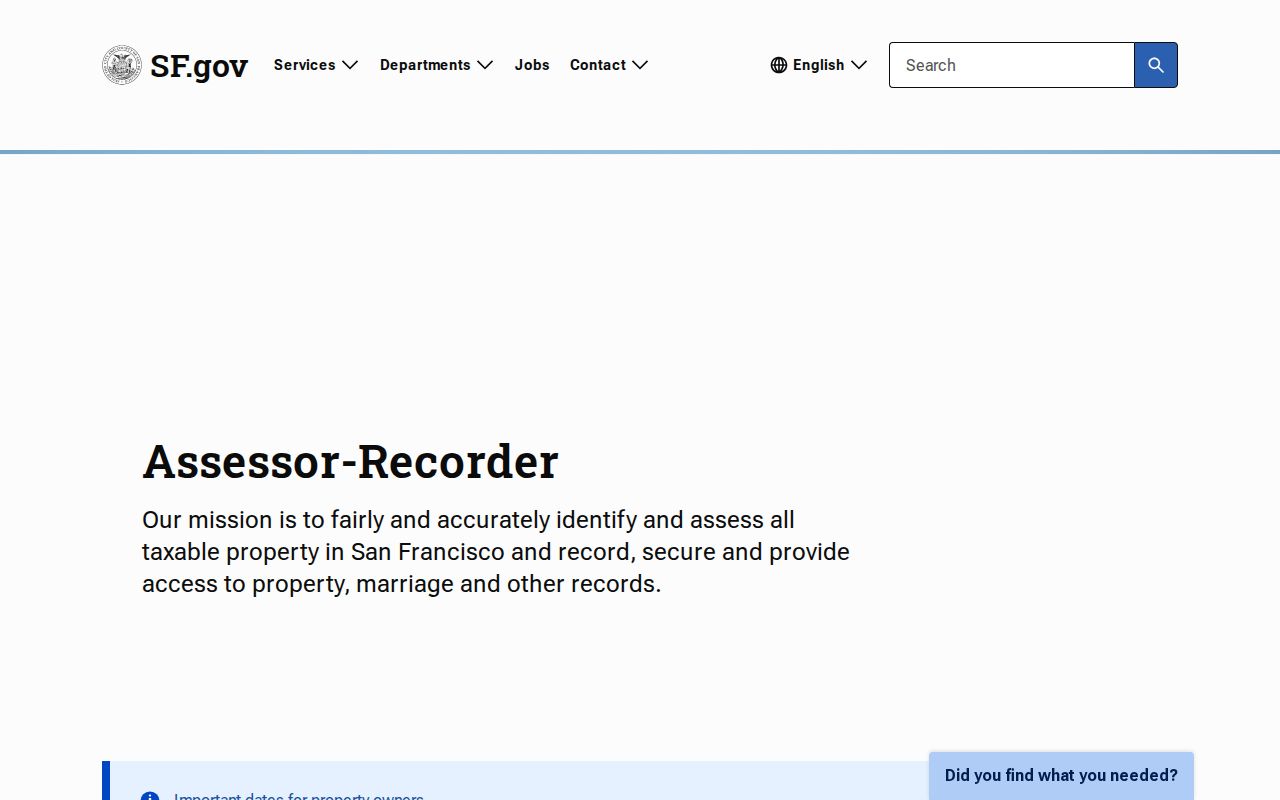
That combined role explains why both Records Manager and the Community Portal belong in the same property-record chain.
San Francisco Clerk Record Services
The County Clerk handles public marriage records issued in San Francisco, fictitious business names, notary services, professional registrations, and several certificate services. Confidential marriage records follow a narrower path, while birth and death work can also involve the Office of Vital Records, DPH, or CDPH based on the event and record age.
The County Clerk's official services page shows the separate route for marriage, certificate, business-name, and registration matters.
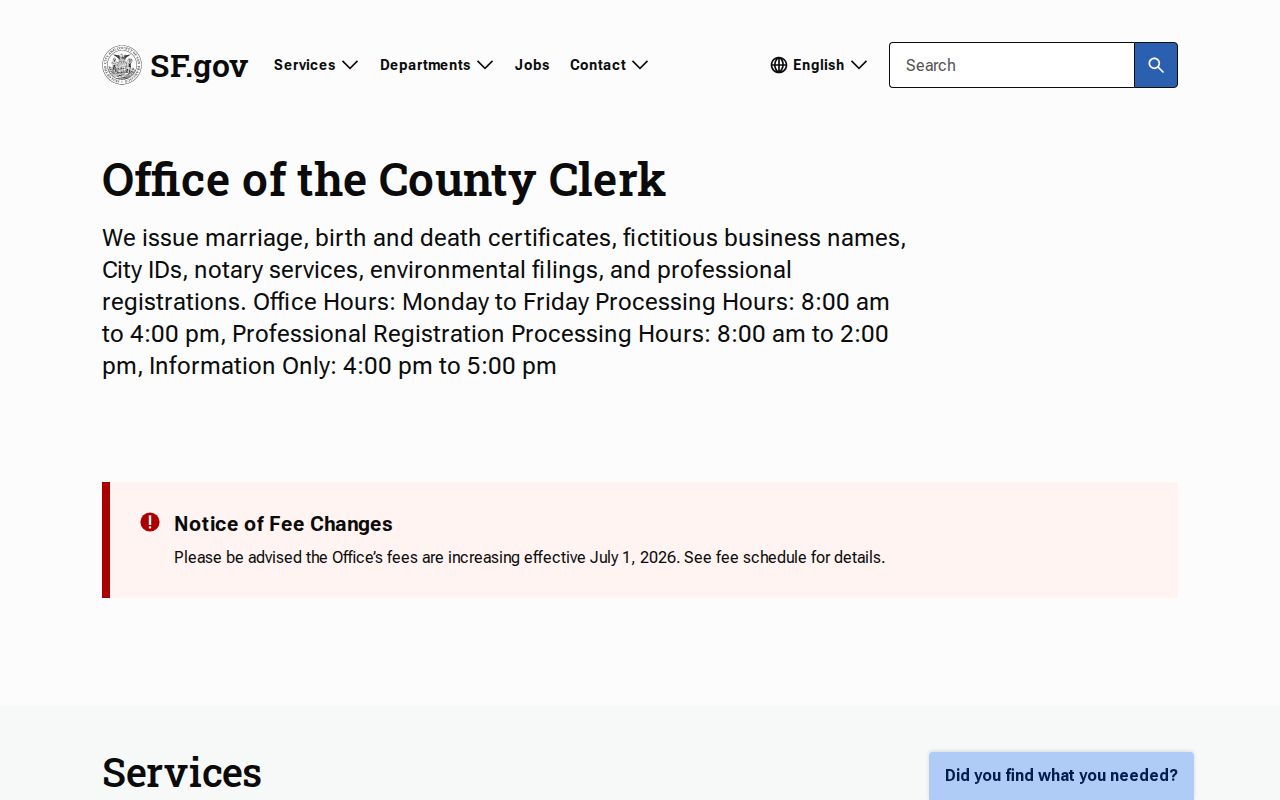
The split prevents a deed-copy request from being sent to the office that handles marriage and certificate services.
San Francisco Court Record Access
The Superior Court Case Information hub covers Unlimited and Limited Civil, Family Law, Probate, and Small Claims cases filed from 1987 to the present. Search routes include case number, last and first name, or case name. Criminal links include a case query, a weekly updated cumulative index, and calendars that reach up to 120 days. The web query uses a verification prompt intended to curb automated abuse.
An online result can identify a case, parties, type, number, and disposition when available. It does not mean every pleading image is posted. Clerk counters and public-access terminals are the next channels for fuller detail, and older material may require a department, microfilm, FamilySearch index, or archive route. The Criminal Records Department can be reached at 415-551-0651; duplicate requests for the same case number slow processing.
Federal San Francisco cases belong to the U.S. District Court for the Northern District of California and its federal docket system, not the local Superior Court. Older federal holdings may move through the clerk or National Archives.
Note: A court index can confirm a case exists, but the clerk remains the copy source for filings not posted online.
San Francisco Vital Record Limits
Current vital certificates are not a general public name index. San Francisco's Office of Vital Records, Department of Public Health, County Clerk, and California Department of Public Health divide work by event, age, and certificate type. Health and Safety Code section 103526 reserves identity-establishing authorized certified copies for listed people and roles. Other requesters may receive a certified informational copy where allowed.
Current local forms set a birth copy at $31 and a death copy at $26. Mailed requests for authorized copies require a sworn statement that is notarized, except for specified agency requests. If no record is found, the fee is retained and a Certificate of No Public Record is issued. Confidential marriage records are limited to the parties unless a court order applies. Divorce decrees come from Superior Court, not DPH.
The San Francisco Office of Vital Records page identifies the local certificate channel.
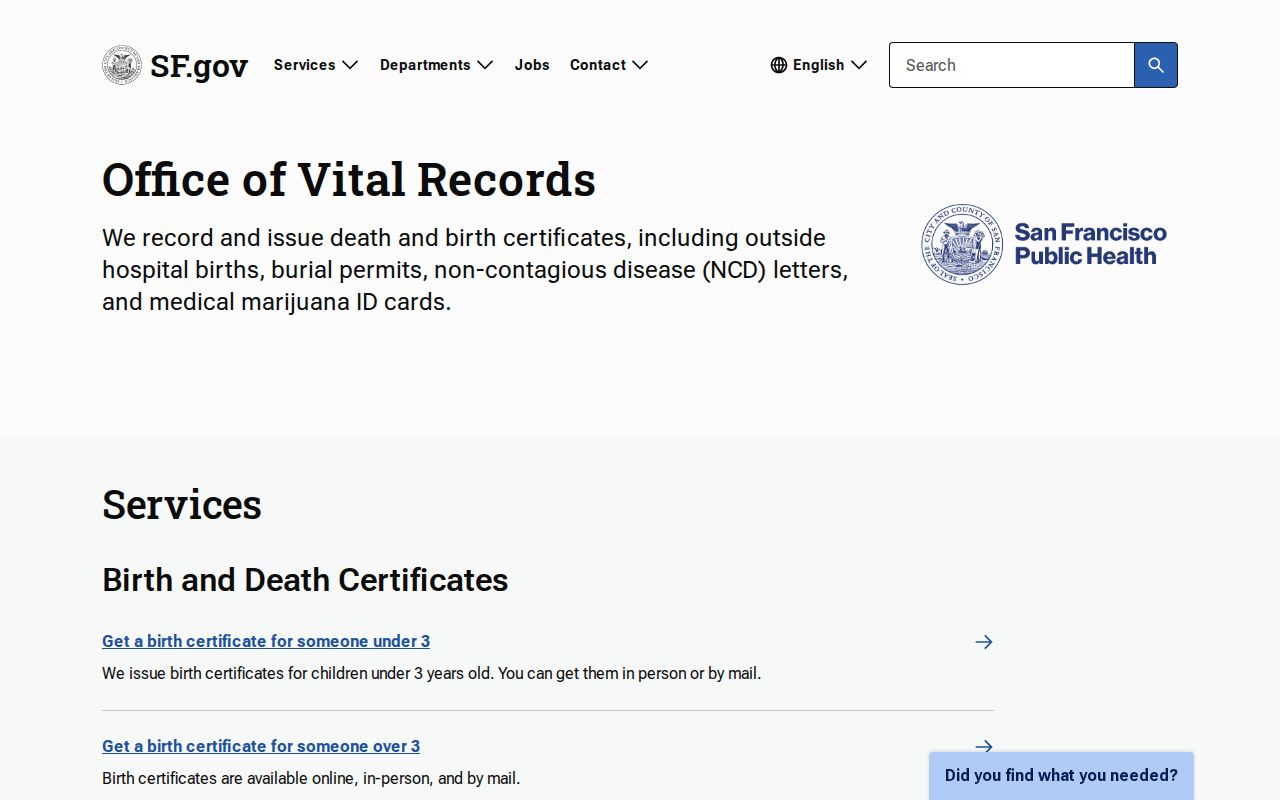
The office page helps separate certificate ordering from historical index research at SFPL and FamilySearch.
San Francisco Custody Record Lookups
The Sheriff's Find a person in jail tool checks current local custody. It accepts the first three letters of both first and last name, a booking number, or an SF number. The SF number is the permanent identifier used within the county jail system. A custody match is not a court disposition, so related case facts still belong with Superior Court.
California prison custody uses CDCR's CIRIS. State descriptions say a current result can include name, CDCR number, age, location, commitment counties, admission date, and parole-hearing dates or outcomes. The Megan's Law registry is a separate California DOJ system, updated daily by law enforcement, with strict legal-use warnings. VINE provides custody status and notification but is not a full historical record file.
Agency files beyond the locator can be requested from the Sheriff. Police and Sheriff disclosures may omit investigatory, juvenile, victim, medical, or privacy-protected matter.
San Francisco Records Fees
Recorder costs change by delivery method. An online document costs $1.81. In-person, mail, and drop-box copies cost $9.70 for the first page plus $0.39 for each added page, and certification of the full document adds $1. Online card checkout adds a $2 service fee, while electronic check is also accepted. Court copy and certification charges should be confirmed through the clerk because the research did not establish one current figure.
CPRA charges generally track direct duplication costs or a fee set by another law. Inspection is often free. Before paying, decide whether an index entry, ordinary copy, or certified copy meets the need. Certification is the custodian's formal attestation that the copy matches its record; it is not needed for every family-history, estate-planning, or property-curiosity search.
- Index
- A finding aid that identifies a record and its key fields.
- Image
- The scanned page or electronic document itself.
- Certified copy
- A copy formally authenticated by its official keeper.
- Custodian
- The agency or office responsible for the requested record.
- Exemption
- A legal basis for withholding all or part of a record.
Closed San Francisco Record Material
Public access has boundaries. Juvenile and adoption matters, sealed cases, confidential marriage files, some family-law details, protected victim or witness data, and medical information may be closed. Record relief can also limit criminal material. Vital images may redact signatures and Social Security numbers, while the Driver's Privacy Protection Act and state law restrict motor-vehicle data.
California's Safe at Home program lets qualified participants use a substitute address. Government Code sections 6205 through 6210 help agencies answer a request without exposing a protected person's changed name or location. Confidential voters are also excluded from ordinary voter-data releases. These safeguards are part of the records system, not errors to bypass.
Use records lawfully. Open information may support genealogy, heir research, civic review, and personal safety. Never use it to stalk, harass, threaten, or harm anyone.
Note: Redaction releases the separable public portion while shielding fields or pages that a specific exemption protects.
Request San Francisco Public Records
A focused request gives the custodian enough detail to locate responsive material without guessing. California agencies generally make a determination within 10 days. Unusual circumstances can support a 14-day extension. San Francisco departments often use NextRequest, while some offices accept their own email, counter, form, mail, or portal channel.
- Choose the custodian. Send deeds to the recorder, cases to the court, and agency files to the department that created or keeps them.
- Check existing access. Search the official index or public request log before asking staff to reproduce material already posted.
- Describe the record. Give a date range, names, case or document numbers, subject, and record type when known.
- State the delivery need. Ask to inspect, receive an electronic copy, or obtain certification. This helps the office identify any lawful fee.
- Review the response. If material is withheld, ask for the cited exemption and whether segregable, non-exempt portions can be released.
- Narrow or pursue review. Refine an overbroad request or use CPRA and Sunshine Ordinance remedies when a denial remains disputed.
A requester need not know an agency's filing vocabulary, but precise terms save time. Keep the request about identifiable records, not a demand that staff answer questions or create a new report.
Note: Save the request number and agency response so later narrowing or Sunshine review starts from a clear record.
San Francisco Records Beyond Portals
Offline routes are essential when a portal ends. Pre-1990 recorded documents go to City Hall Room 190. Court terminals and clerks may provide detail that the public web query does not. Vital certificate applications can travel by mail under the sworn-statement rules. Recorder copies can also be ordered in person, by mail, or through a drop box, while broad agency requests can use NextRequest, email, or a department counter.
For older San Francisco evidence, the History Center and SFPL extend the trail through deed indexes, block books, city directories, reverse directories, phone books, Great Registers, historical newspapers, and probate or vital indexes. The Assessor-Recorder can research ownership transfers from 1914 forward, while incomplete deed resources reach into the nineteenth century. These library and archive channels are especially useful for family history, former classmates, and heirs when current web systems have no answer.
San Francisco's consolidated government makes the custodian map compact, but it does not make all records digital. The most reliable access plan uses the portal for discovery, the responsible office for copies, and the library or archives when the date falls outside modern coverage.