
Mapping San Francisco People Directories
San Francisco people directories answer different questions because each keeper lists a defined group. City pages identify officials, commission members, and selected department contacts. Campus tools cover faculty, staff, and departments. Recorded-document indexes identify parties to deeds and other filings, while parcel tools organize facts by address and block-lot. The San Francisco Public Library preserves the long view through city directories, reverse directories, phone books, voter registers, and yearbooks.
| Directory | Who It Lists | Keeper | Access |
|---|---|---|---|
| SF.gov departments and commissions | Officials, commission members, department contacts | City and County of San Francisco | Free current pages |
| UCSF and USF directories | University people, departments, and faculty | UCSF and University of San Francisco | Free online |
| SFUSD directory pages | School staff and department contacts | SFUSD and California Department of Education | Free online |
| Recorded-document index | Grantors and grantees on official records | San Francisco Assessor-Recorder | 1990-present online; older search at City Hall |
| City and reverse directories | Past residents, firms, and address-linked occupants | San Francisco Public Library | Print, microform, and selected online access |
| Professional and business registers | Licensees, attorneys, contractors, and entities | California boards and Secretary of State | Free official searches |
Begin with the role or time period, not a broad name query. A city official belongs in department or commission pages. A university affiliation points to a campus directory. An old address calls for a reverse directory. A deed party belongs in the recorder index. This split is useful: each result carries the context needed to tell two people with the same name apart.
San Francisco Government Directory Paths
San Francisco's consolidated city and county government does not publish one complete employee-name directory. The practical starting point is the SF.gov department system, followed by an agency contact page, staff PDF, elected-official page, or public commission roster. Those sources focus on public duties. A listing may provide a name, role, office line, public email, meeting body, or department, but the fields vary by agency.
State personnel contacts are organized differently. The California Personnel Office Directory lists personnel-office contacts by agency rather than every state worker. Its entries can include a contact name, telephone number, email, physical or mailing address, and agency codes. The alphabetical directory is most useful when the agency is known but its administrative contact is not.
The State Controller's directory page shows the form and scope of these public contacts.
Open the California Personnel Office Directory source before reviewing the captured directory page.
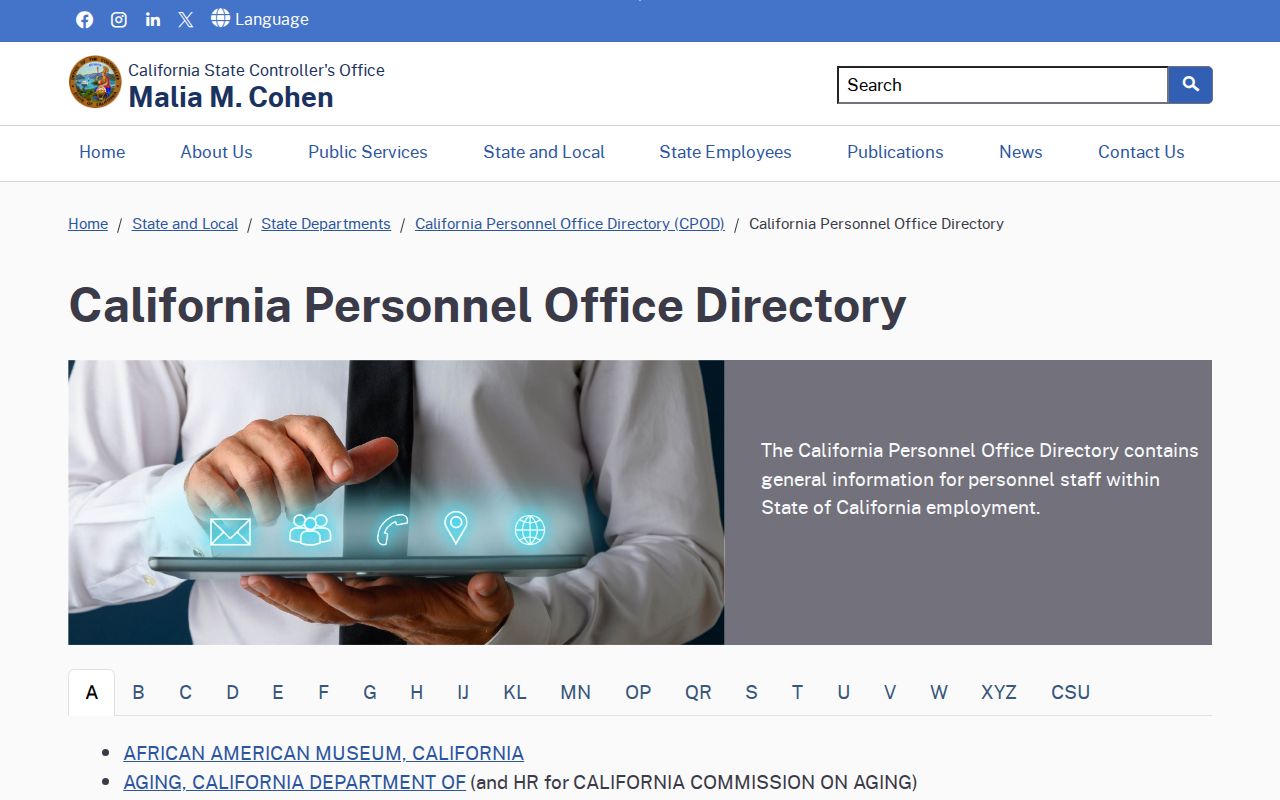
The alphabetical layout reinforces an important limit: this is an agency personnel-office directory, not a roster of every person serving the state.
San Francisco Education Directory Searches
Education listings form the most complete set of current San Francisco people directories found in official sources. The UCSF Directory separates people from departments, so a surname or other keyword belongs in People Search while an organizational term belongs in Department Search. The University of San Francisco publishes faculty entries, and SFUSD provides department contacts plus school-level staff pages.
| UCSF field | Input type | Required | How it works |
|---|---|---|---|
| People Search Keywords | Text | Yes | Searches people |
| People Search | Button | Not applicable | Runs the person query |
| Department Search Keywords | Text | Yes | Searches departments |
| Department Search | Button | Not applicable | Runs the department query |
Visit the UCSF people and department search to compare its two keyword paths with the captured interface.
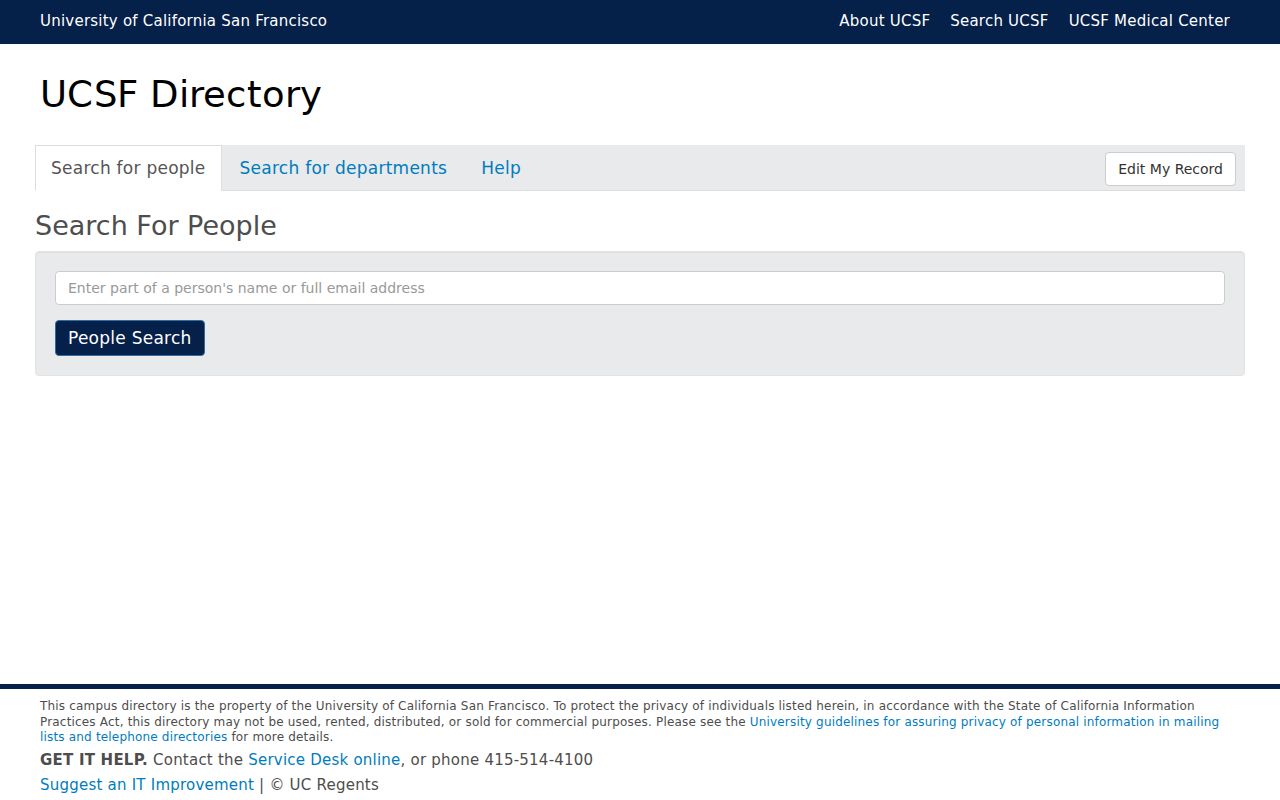
The two search modes prevent a department query from being mistaken for a person-name result.
View the University of San Francisco faculty directory source for public faculty profiles.
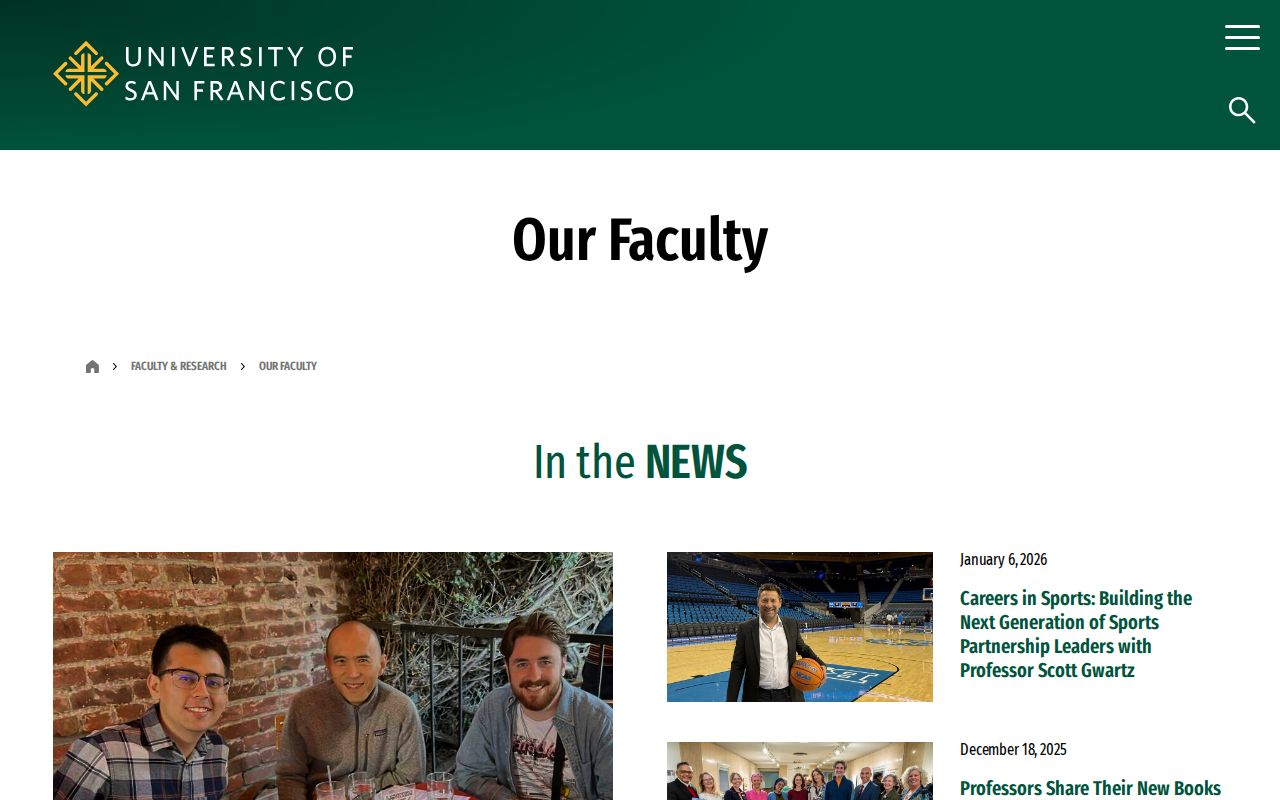
USF entries add academic context through titles, email links, and a campus or office location when one is posted.
Check the SFUSD departmental directory source for district office contacts.
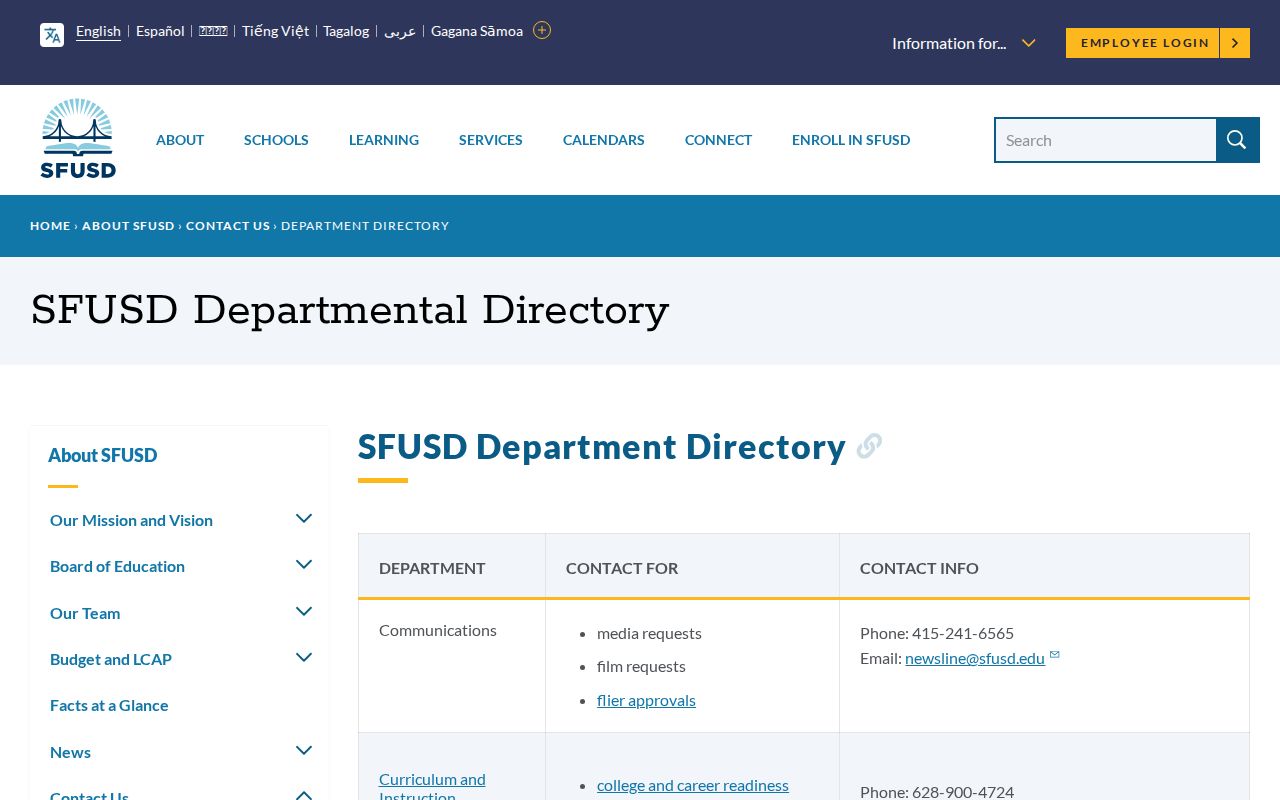
The SFUSD view is organized around departments, so school-specific faculty and staff pages remain the better path when the campus is known.
What San Francisco Directory Entries Show
A useful directory result identifies both a person and the institution that gives the listing meaning. UCSF profile pages commonly show a name, title or rank, department or division, UCSF Health affiliation, email link, and a phone number when public. Typical USF faculty entries show a name, academic title, public university email, and sometimes a campus building or office.
| Name | The displayed personal or professional name |
|---|---|
| Title or rank | The person's public role, such as professor or faculty emeritus |
| Department | The school, division, or unit tied to the entry |
| Public contact | An institutional email or phone number when posted |
| Location | A campus, building, or office when the directory supplies one |
| Affiliation | A health-system or other institutional connection where shown |
Compare the department, title, and institution before treating a matching name as the right person. Pagination also matters in the USF directory because a match may sit beyond the first results page. A missing field means only that it was not published in that entry.
Note: Public institutional contact details should be used for respectful, relevant communication and never to stalk, harass, or harm anyone.
San Francisco Property Name Directories
Property systems act like directories, but San Francisco geography sets the rules. The Property Information Map accepts an address, a block-lot number, a street intersection, or a map selection. It returns the parcel number and other property facts. The Assessor-Recorder Community Portal also searches by block, block and lot, or structured address. An Assessor's Parcel Number, or APN, is the local block-lot identifier used to connect those property tools with official records.
The recorded-document system then works as a name directory. Its grantor and grantee fields list parties to deeds, liens, releases, reconveyances, and other records from 1990 forward. A grantor gives or transfers an interest; a grantee receives it. The recorder does not search by street address, so the address must first be converted to block-lot through PIM or the assessor portal.
San Francisco address trail: street address → PIM block-lot → assessor property details → recorder APN or grantor/grantee search.
The online recorder index starts in 1990. Earlier official records require an in-person search at City Hall, Room 190, while incomplete deed indexes from 1848 through 1913 are also available through SFPL and FamilySearch. For access rules and copy procedures, use the separate San Francisco public records access reference.
Professional Directories Across San Francisco
Official license and business systems help distinguish a person acting in a regulated or registered role. The California Department of Consumer Affairs search accepts first name, last name, license number, business name, and board or license filters. Results can show whether a credential is current or expired and may flag discipline, suspension, or revocation. Contractor searches add business and personnel-name routes, while the State Bar directory uses an attorney name or bar number.
The California Secretary of State business search covers corporations, limited liability companies, limited partnerships, and their public filings. Results can include the entity name, registration number, status, agent for service of process, addresses, and filing PDFs. A UCC search is different: it organizes lien notices by debtor, secured party, or file number. San Francisco fictitious business name filings through the County Clerk may connect a trade name with a local registrant, though the current search fields and fees were not confirmed in the research.
Use the narrowest official register that fits the role. A professional directory documents a license or entity connection, not a complete account of a person's identity or history.
San Francisco Phone and Reverse Directories
The San Francisco Public Library directory collection is the authoritative source for the city's historical phone and address lists. Its phone books span 1899 to the current period on microform and 1921 to 2006 in print. Not every year is held. The Magazines and Newspapers Center asks researchers to check availability before a visit.
Reverse directories answer the opposite question from an alphabetical city directory. Polk's volumes run from 1953 through 1982, and Haines volumes run from 1976 to the current period in the listed print holdings. Instead of starting with a surname, a reverse directory begins with a street address and identifies the occupant associated with it. That makes it useful for tracing who was listed at one flat, storefront, or building during a given year.
- City directory
- An alphabetical name list that often links a resident or firm with an address and occupation.
- Reverse directory
- An address-first list used to identify the occupant associated with a street location.
- Microform
- A reduced photographic copy read on library equipment, often used to preserve long runs of old volumes.
Andrews Real Property Directory adds another address-first source for 1943 and 1949, listing San Francisco streets alphabetically with owner names.
San Francisco Classmate Directory Trails
SFPL's high school yearbook collection reaches back to the 1800s. Names, class groupings, activities, and photographs can help a family researcher identify a relative or reconnect a former classmate when a current web directory has no useful trace. Historical newspapers then add obituaries, family notices, school events, business moves, and neighborhood detail. These records are strongest when a school, year, street, or relative is already known.
Review SFPL's genealogy resource source before using its newspaper, yearbook, and FamilySearch options.
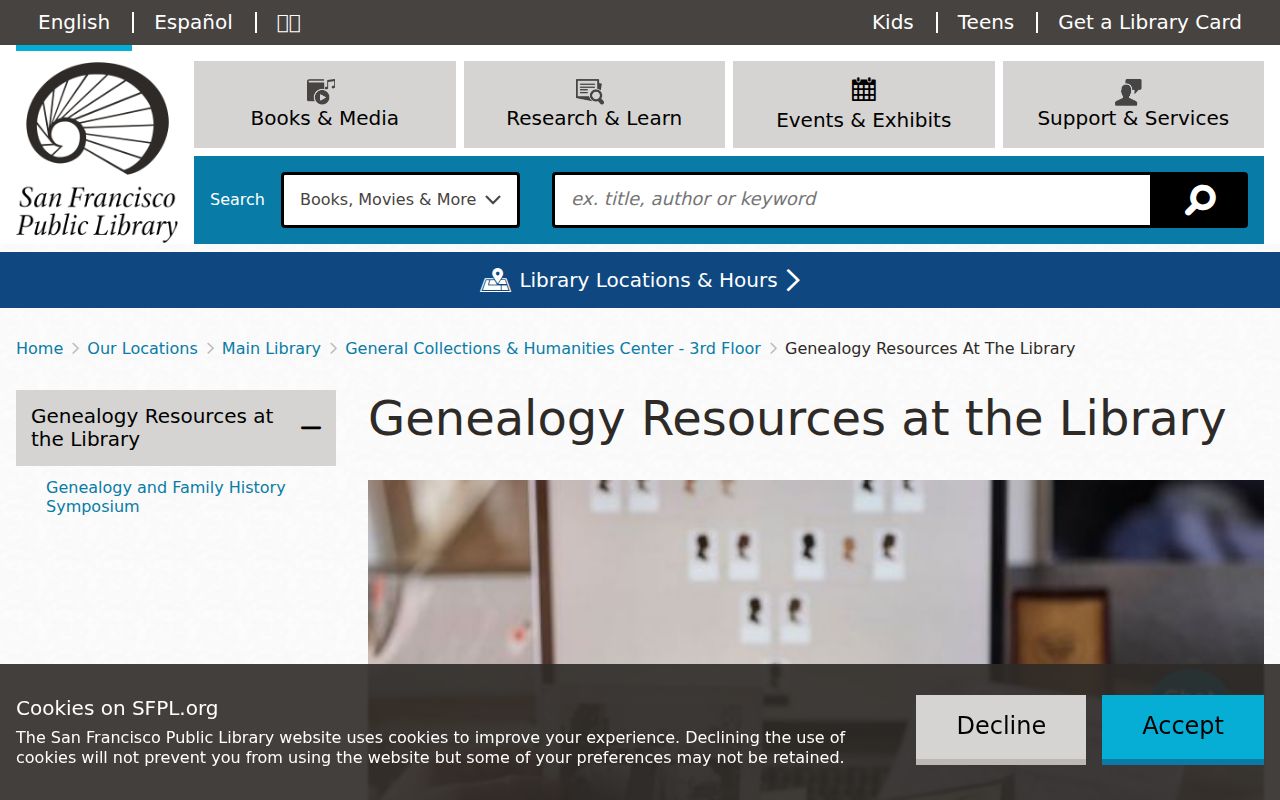
The library page shows why a historical people search often needs several collections instead of one modern name box.
Great Registers provide another directory-like source. SFPL holdings cover 1866 through 1964 and 1985, though the run is incomplete, and 1867 through 1940 is available online. Entries can show name, address, age, political affiliation, and sometimes occupation. Access to the 1945 through 1964 registers requires 48-hour notice, and the correct assembly district must first be identified.
San Francisco Directories Through 1906
The 1906 earthquake and fire broke many ordinary record trails. San Francisco directories and parallel sources help rebuild them. October 1906 block books, post-fire city directories, newspapers, voter registers, deed indexes, permits, and insurance records can place a person, household, or owner after other files were lost. The library's city directory holdings span 1850 through 1960 on microform and 1875 through 1982 in print, with gaps in both runs.
| Years | San Francisco directory milestone |
|---|---|
| 1848-1913 | Incomplete grantor/grantee deed index held through SFPL and FamilySearch pathways |
| 1850-1960 | City directories on microform at SFPL |
| 1875-1982 | City directories in print at SFPL |
| 1899-current | Phone books on microform, with gaps |
| 1906 | Earthquake and fire make post-disaster block books and reconstructed sources vital |
| 1953-current | Polk's and Haines reverse-directory series overlap across different years |
| 1990-present | Recorded-document name index available online |
Search adjacent years when a name is absent. San Francisco directories may use initials, a spouse or widow notation, an occupation, a firm name, or a changed surname. Older printed indexes may also contain spelling and transcription differences. Those details can separate same-name residents and reveal a move between editions.
San Francisco Community Directory Sources
The San Francisco History Center is both a local-history collection and the archives for the City and County. Its books, newspapers, maps, photographs, manuscript collections, ephemera, and biography files provide context that a bare directory entry cannot. The center is especially useful for an old address, a civic group, a neighborhood business, or a person whose trail predates modern portals.
Community history can change which directory works best. Chinese American family research may lead to the Chinese Historical Society of America or to National Archives holdings for the San Francisco region, including passenger arrivals, federal naturalization indexes, and Chinese immigration files. SFPL also points researchers to the African American Historical and Cultural Society, the San Francisco Bay Area Jewish Genealogical Society, the California Genealogical Society, and Sutro Library at San Francisco State University.
Use a society or archive catalog to locate a named collection before assuming a roster exists. Funeral notices and obituaries can connect survivors, churches, cemeteries, and fraternal groups, but such sources deserve care and respect. A directory entry is a starting fact, not a full portrait of a life.